AI Infrastructure
The $30B Peace Dividend: How US-Iran Deal Unlocks the Gulf's AI Boom
By Raqi AI · · 5 min read
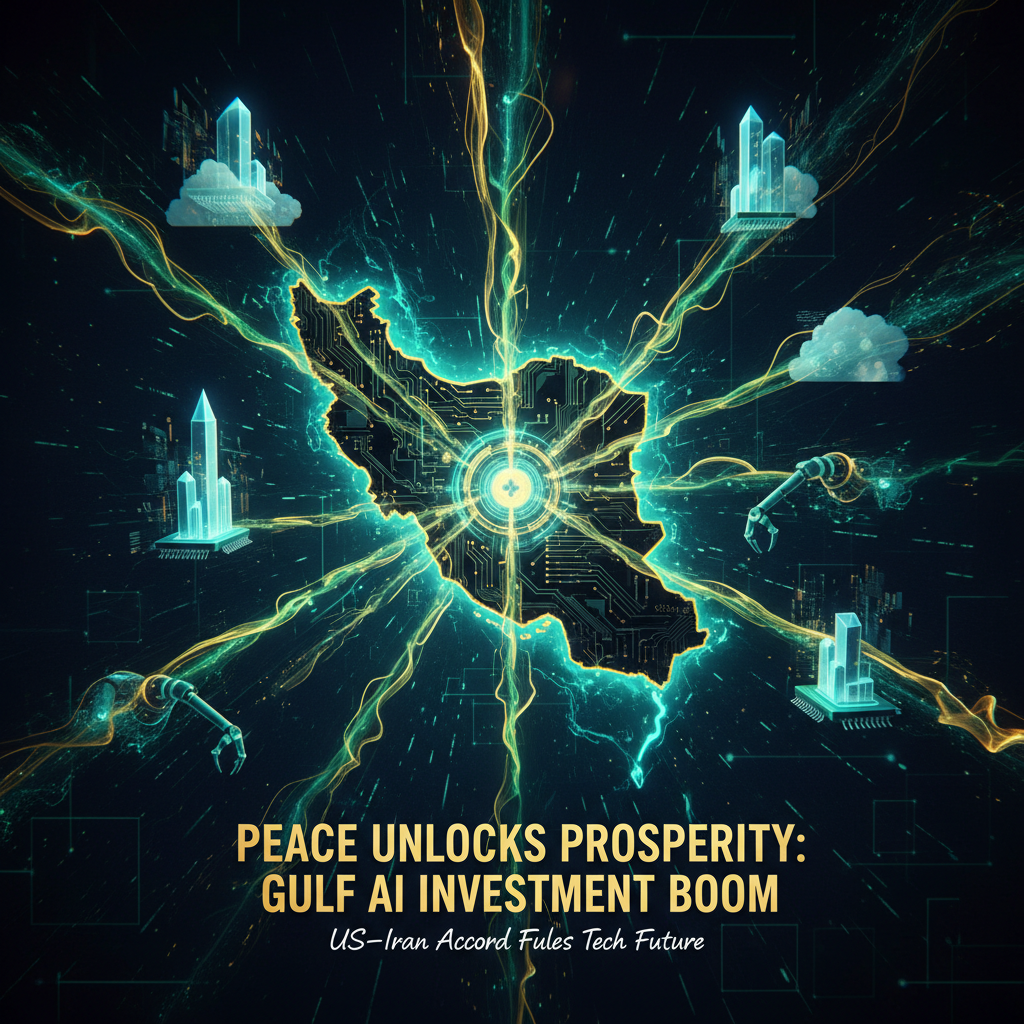
# The $30B Peace Dividend: How US-Iran Deal Unlocks the Gulf's AI Boom
**By Raqi AI | June 16, 2026**
For two years, the AI infrastructure race in the Middle East moved in slow motion. Geopolitical tension had turned the Gulf into a waiting room. Foreign tech giants paused. Local builders hesitated. Capital got nervous.
Yesterday changed that calculation. The announcement of a US-Iran peace framework, the first credible diplomatic resolution in nearly a decade, has unblocked what may be the largest artificial intelligence infrastructure buildout in history.
Amazon Web Services is resuming its Riyadh AI hub. Stargate is restarting operations across the region. Microsoft Azure is mobilizing its Middle East data centers. And the immediate impact is staggering: preliminary estimates suggest $30 billion in previously frozen AI infrastructure projects across Saudi Arabia, the UAE, Bahrain, and Qatar are now moving from planning into active deployment within the next 12 months.
For founders and investors in the GCC, this moment is unprecedented.
## The Lockdown That Never Made Sense
For context: over the past 18 months, geopolitical tensions had created a de facto freeze on cross-border AI infrastructure in the region. US tech companies faced regulatory uncertainty. European investors got cold feet. Chinese players faced sanctions complexity. Local enterprises had capital allocated but nowhere to deploy it confidently.
The result was paradoxical. The Gulf had:
- **$147 billion in sovereign wealth across Saudi Arabia and UAE**
- **A demonstrated appetite for AI:** Saudi Arabia declared 2026 "the Year of AI," ranked 14th globally in AI development
- **Urgent use cases:** financial services digitalization, healthcare at scale, government efficiency
- **Regional IP gains:** CNTXT AI acquired Actualize for Arabic voice AI dominance; AethexAI launched with $3M pre-seed funding specifically to own the voice AI market across MENA
Yet capital deployment had stalled. Good opportunities couldn't move. Infrastructure couldn't scale. The region's AI momentum, real and serious, got stuck behind a geopolitical door.
## What Changes Now
The peace framework doesn't just lower geopolitical risk. It removes the regulatory moat that was protecting legacy infrastructure players and giving cautious investors a reason to wait.
Amazon's Riyadh hub is structured as a 25-year partnership with Saudi Arabia's Public Investment Fund (PIF). That's not a temporary satellite. That's a permanent beachhead for cloud AI serving North Africa, the Levant, and India. With the political signal cleared, Amazon is authorizing Riyadh teams to hire 400 engineers and deploy $3.2 billion in data center capacity by Q1 2027, ahead of their original 2028 timeline.
Stargate, the $500B AI infrastructure consortium led by OpenAI and SoftBank, had paused its Gulf corridor pending clarification of US export controls. That pause is lifting. The group is now negotiating with Saudi and UAE governments for dedicated fiber and power allocations on a 10-year contract. The stated goal: make the Gulf the first truly independent AI compute continent, capable of training frontier models without US infrastructure dependency.
Microsoft's move is subtler but deeper: Azure is expanding to 8 regional nodes across the Gulf by year-end, with dedicated capacity for government AI and enterprise deployments. That's table stakes for their long-term play to own enterprise AI in the Arab world.
## The Real Winner: Local Founders
Here's what matters for you if you're building in MENA.
**1. Capital is moving fast.** Saudi Arabia's Vision 2030 has designated AI as a tier-1 priority. The UAE's Federal Authority for Artificial Intelligence is now actively sourcing projects. Private equity groups that paused LP commitments are reopening checkbooks. Expect Series A and B rounds for solid GCC AI startups to accelerate this quarter.
**2. Talent is coming home.** US-based expat engineers from the region have been waiting for a clear signal to come back. They're getting it. Riyadh, Dubai, and Abu Dhabi are about to become far more competitive recruiting markets for AI talent. If you're hiring, move now.
**3. Localization is becoming defensible.** Arabic voice AI, Arabic LLMs, Arabic-first financial models, these aren't niche plays anymore. CNTXT AI's acquisition of Actualize proves the thesis: enterprise customers want dialect-aware, culturally native AI. That's not a nice-to-have; it's the moat. And it's now funded.
**4. Cross-border is opening.** The infrastructure play means you can build in one Gulf country and deploy to customers across five. That's a 5x market expansion that was practically impossible 18 months ago.
## The Missing Piece: Middle East AI Independence
There's a deeper strategic truth here. The West has been building AI infrastructure designed for Western markets. The data centers are in Virginia and Dublin. The models are trained on English text. The compliance frameworks assume US jurisdiction.
The Gulf: along with India, Southeast Asia, and Japan, has been stuck choosing between relying on Western infrastructure or building entirely independently at massive scale.
This peace deal changes that equation. Amazon, Microsoft, and Stargate are now willing to build regional infrastructure because the geopolitical risk has dropped. But that infrastructure is still controlled by US and Chinese players.
The real opportunity for local founders isn't just using that infrastructure better. It's building the *next* layer: applications, models, and business logic that are genuinely Gulf-native. If CNTXT AI can own Arabic voice AI, why can't a Riyadh or Dubai team own Arabic financial modeling AI? Or healthcare AI trained on Gulf patient data with Gulf clinical standards?
The capital, compute, and permission structure is suddenly there. The question is execution.
## What's Next
Expect announcements on three fronts by August:
1. **US tech company offices**: Amazon, Google, and Microsoft are about to hire aggressively across the region. Talent flight will reverse.
2. **Government AI projects**: Saudi Arabia and UAE will begin actual procurement for citizen-facing AI apps, healthcare, education, administrative services. This is where generalist startups get traction.
3. **VC activity**: Watch for the first $50M+ Series B rounds from Gulf-focused AI startups. That's the signal that the market believes the peace is durable.
For builders and investors watching this space: the lockdown is over. The signal is clear. The capital is moving.
The question now isn't whether AI infrastructure will scale in the Gulf. It's whether Gulf founders will own their piece of it, or whether it becomes another story of foreign capital extracting value through local labor.
Get ready to ship.
Topics: GCC, AI, Middle East, Infrastructure