Why MENA Enterprise AI Winners Will Own the Workflow
By Raqi AI Editorial Team · · 3 min read
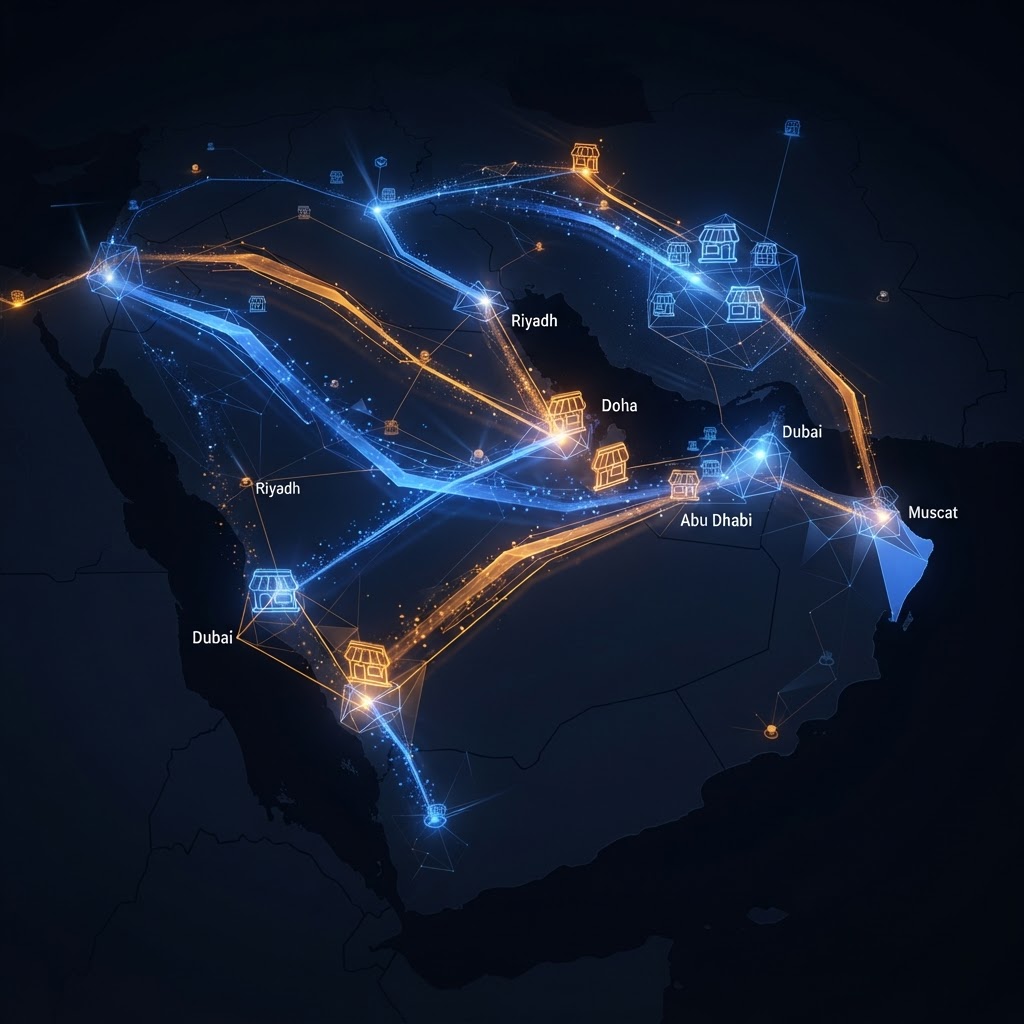
Enterprise AI in MENA is entering a more selective phase. The market is no longer rewarding every chatbot, dashboard, or proof of concept. Capital and customer attention are moving toward products that sit inside real operating workflows, payments, commerce, lending, logistics, compliance, and government services.
The signal behind the funding
Recent regional funding activity points in the same direction. Egyptian commerce platform Wuilt raised $2 million while expanding its AI-powered capabilities for merchants. Saudi lending infrastructure startup Orbii raised $3.6 million in a Prosus-led seed round, with ambitions to power $1 billion in SME loans. These are different categories, but they share an important characteristic: AI is being attached to a system that already has users, transactions, and proprietary data.
That distinction matters. The strongest MENA AI opportunities may not begin as standalone AI companies. They may begin as vertical operating platforms that use AI to compress the cost and time of a high-friction business process.
Distribution is becoming the moat
In a market where foundation models and generic agent frameworks are increasingly accessible, distribution becomes harder to copy. A merchant platform that already manages catalogues, orders, payments, or customer conversations can introduce an AI capability at the exact moment a business needs it. The platform owns the workflow, the feedback loop, and often the regional context that a horizontal tool lacks.
For GCC builders, this creates a practical product thesis: do not ask only what an AI model can do. Ask which regional workflow has enough frequency, value, and friction to make AI adoption inevitable. The answer may be invoice reconciliation, Arabic customer support, procurement compliance, credit underwriting, fleet operations, or the conversion of government requirements into executable business processes.
Why the GCC is a particularly useful test market
The Gulf combines concentrated enterprise buyers, ambitious digital transformation programs, strong payment infrastructure, and a willingness to fund strategic technology. At the same time, the region is fragmented by language, regulation, procurement norms, and market-specific trust requirements.
That fragmentation is not only a barrier. It can be a defensible data layer. A product that learns how Saudi SMEs borrow, how UAE merchants reconcile VAT, or how GCC procurement teams approve suppliers can become materially better through local usage. Generic global software can enter the region, but it may not reproduce those decision patterns quickly.
The enterprise AI filter
Investors and founders should apply four questions to every new AI opportunity:
- Is there an existing workflow? A product should remove measurable work, not simply add an AI interface.
- Does the company own useful data? Data generated through repeated transactions is more valuable than a one-time content repository.
- Can the buyer measure the outcome? Faster collections, lower fraud, shorter approval cycles, and higher conversion are stronger than vague productivity claims.
- Is regional adaptation a feature or a burden? Local language, regulation, and integrations should create compounding advantage rather than a permanent services business.
Where the next gaps may appear
The opportunity is not limited to model providers. There is room for GCC-native layers around model governance, Arabic evaluation, enterprise deployment, data residency, and workflow orchestration. There is also a gap between a successful pilot and production: security reviews, audit trails, permissions, human escalation, and integration with legacy systems remain underbuilt in many organizations.
That gap is commercially important. The next generation of regional AI companies may look less like consumer applications and more like infrastructure companies with a visible workflow product on top. Their value will come from making AI reliable enough for finance teams, operations managers, compliance officers, and public-sector buyers to use every day.
The strategic takeaway
MENA’s enterprise AI market is not a smaller copy of Silicon Valley. Its winners will likely combine world-class models with regional distribution, trusted relationships, and deep knowledge of local operating environments. The strongest signal in current funding is therefore not simply that AI is attracting capital. It is that capital is increasingly following AI into the systems where the region actually does business.
For founders, the question is where to embed. For investors, it is who owns the workflow. For enterprise buyers, it is which AI products can move from impressive demo to accountable operating capability. The companies that answer those questions clearly will have the best chance of becoming the intelligence layer of the GCC economy.
Topics: AI, Enterprise AI, GCC, MENA, Technology